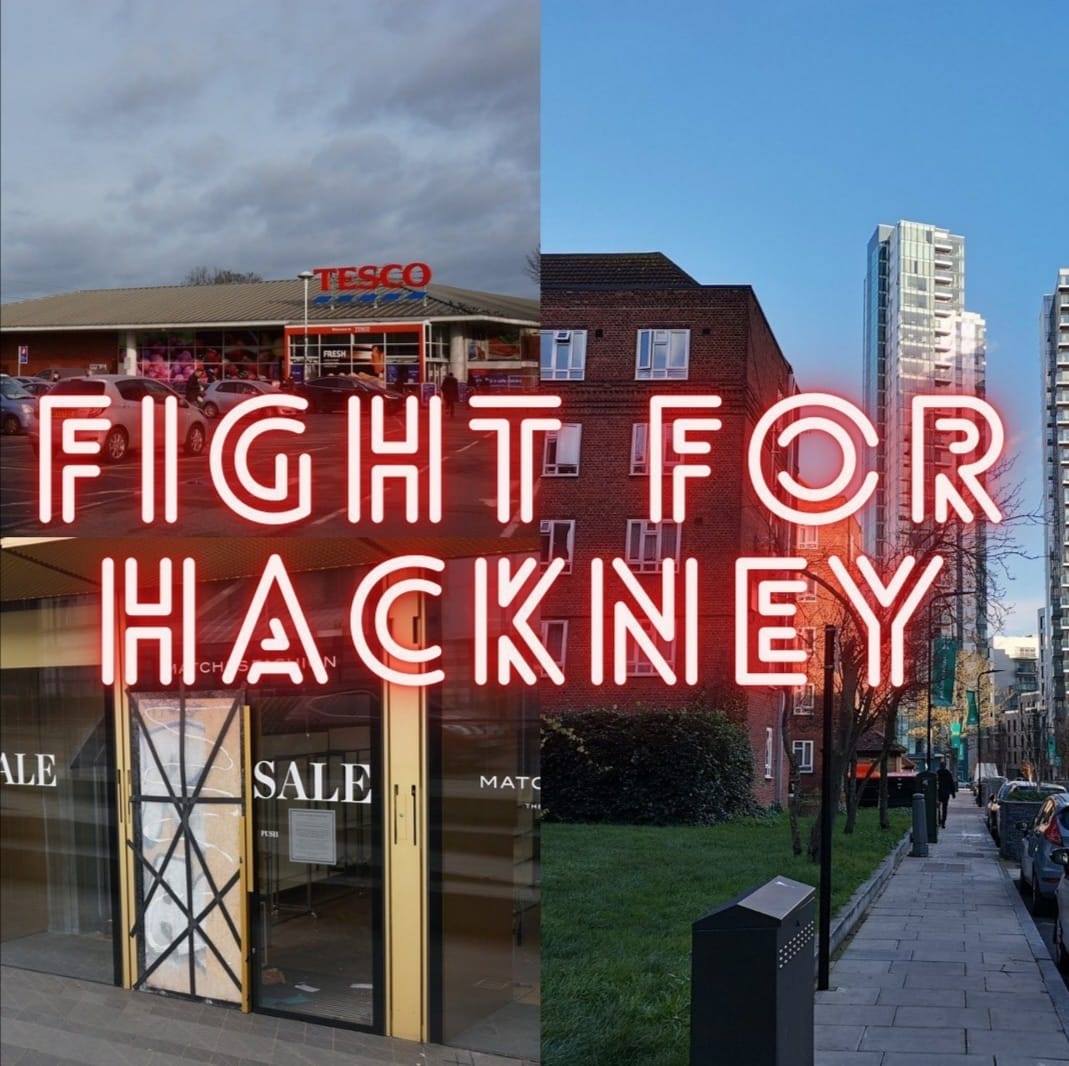
Hackney Council is asking residents what we want to see in the Local Plan which will set out how land is used in our borough including policies on housing, shopping, workspace, transport, design, town centres, and public spaces. The Plan and surveys to respond to it are on the Council website. The deadline to respond is midnight on 2nd November. If, like us, you think there are problems with the surveys, you can email a response to: consultation@hackney.gov.uk. Our response is below – it’s in two parts:
- Our priorities for Hackney
- How the Council can consult residents
It draws on over six years of engaging residents via public meetings, leafleting, surveys and social media. We have gathered the views of thousands of people on the 55 Morning Lane site in Hackney Central. Our work, which is outlined here, has implications for planning policy beyond this site which we draw out in this response.
Our top three priorities (as requested in Section 3)
SOCIAL AND COUNCIL HOUSING
Hackney needs not just more housing but more social housing and, above all, council housing. “Social housing” usually means homes provided by housing associations, now referred to as ‘Private Registered Providers’. The 55 Morning Lane site, owned by Hackney Council, is an opportunity to build good public council housing – so critically needed. We must have no more developments that are dominated by private flats which provide few, if any, homes for people on the housing waiting list, while gentrifying Hackney leaving many who live here to feel shut out. The Council must urgently explore ways to fund the housing we need and alternatives to the developer model of ‘viability’, and we would welcome an opportunity to collaborate on both of those.
The terms ‘affordable housing’ and ‘genuinely affordable housing’ should be avoided as most so-called affordable housing is not affordable for the majority of Hackney’s residents. Similarly, most people do not know the policy meaning of ‘genuinely affordable’ housing and do not view shared ownership properties to be ‘genuinely affordable’. The only genuinely affordable housing is social rent housing and the question on priorities in the consultation survey should offer that as an option and not require people to use the ‘other’ box to register it. Where national planning policy makes it impossible to completely avoid the term ‘affordable’, the Council must always be broken down into tenures (social rent, London Living Rent, etc.) with explicit targets for social rent homes
LARGE SUPERMARKETS
In Hackney, as in other parts of London, we have lost some of our desperately-needed large supermarkets. The Council must prioritise maintaining a supermarket of the same size in the centre of Hackney at 55 Morning Lane and not losing any more of our borough’s big supermarkets. Both of our surveys show this is the second priority for residents using the Morning Lane site after social rent housing. Once again the pre-set options on the Council’s Hackney Plan consultation survey do not allow people to register this priority except via the ‘other’ box.
COMMUNITY and SPACIOUSNESS
People want spaces where everyone has a sense of belonging and ownership and where they can spend time together without having to buy anything. They want these spaces to be attractive and to fit into their surroundings. They want public not privatised spaces, low rise not high rise buildings, and to minimise pollution and noise. Hackney Town Centre is ours and the Council must prioritise ensuring that that guides its development. Specifically, 55 Morning Lane should contain no tower blocks, the land should remain in public ownership, and include community resources.
2. How to engage residents (as requested in Section 7)
We would be happy to work with the Council to incorporate our methodologies outlined below into your Statement of Community Involvement when you review it. We have built up a body of experience with engagement and co-design that could benefit the Council. In what follows, we give the Council’s questions in italics, followed by our responses.
How can we effectively promote consultations to ensure they reach the widest possible audiences?
You can ensure your consultations reach wide audiences by being in spaces used by a diversity of residents, by being there repeatedly, over years, and by talking to people and engaging with them openly. MOPS has demonstrated this by leafleting, surveying, and having conversations with people outside the Morning Lane Tesco for about three months a year across seven years. Time investment and continuity are crucial. Council attempts to have a presence in this and similar spaces have been too few and for too short a duration. As well as our presence outside Tesco, we have spoken to parents and staff outside schools, to community groups, to church members, and to residents’ groups. This type of engagement could be extended by the Council, identifying and targeting marginalised groups who are less likely to attend consultation-type events in official spaces.
How can we prepare consultation materials to ensure they’re clear, understandable, and accessible to all?
Both MOPS surveys relied on straightforward open questions, contrasting with Council consultations which over-use narrow closed questions that risk shaping results to fit the Council’s agenda. This is also a problem with the survey for the current consultation as we noted above. Similarly, a previous questionnaire about priorities for Hackney Central asked about safe streets and tree planting but included no questions at all on housing. Sometimes, Council consultations are misleading. For example, the report on the 2020-21 consultation on social housing allocation interpreted all those who agreed with allocating housing by need as supporting the ejection of thousands of families from the housing waiting list.
What kind of events should we organise as part of consultations?
Public meetings are an important element of consultation; transparency and co-design are crucial. MOPS has organised public meetings with 40-100 attendees for the last six and a half years. As we show in our report on the 2024 Council consultation, the Council’s public workshops had pre-determined agendas and outcomes, with limited opportunities for these to be shaped by residents. It has taken us time to get participants who do not normally take part in consultations involved. Crucial to doing this have been us building relationships and trust and offering a hot meal as part of all our public meetings and using inclusive formats such as small group discussions. Residents (like council officers) should be paid for the time they spend contributing to consultations.
How should we collect responses to consultations?
MOPS has used paper and online surveys to gather responses. We are lucky to have professional researchers among our local volunteers to help analyse the resulting data. Analysing data in a way that honours those who take part in research requires time and money, and it requires researchers who have an understanding of the context and are seeking meanings in the data rather than imposing meanings onto them. Too often Hackney Council fails to make the most of the time and money spent collecting data by not investing time and money in analysing them.
How can we effectively show the results of consultations?
There should be clear reporting on what the Council has learnt from the community through a particular consultation and how this has or is going to shape their actions. Consultations should be seen as moments in an ongoing dialogue between the Council and the community, not as a task-and-finish activity as at present. MOPS has modelled this approach, publishing the results of all our engagement work on our website in posts and reports, and including summaries in leaflets. We share these via our growing email list, social media channels, regular stalls outside Tesco, and public meetings. This approach means that we get more reliable results because we are constantly checking our interpretations with the population and crucially it builds trust.
How can we best keep people updated on Local Plan progress in-between consultation periods?
Between consultations, the Council can communicate via website and social media posts, leafleting on the ground, public meetings, and an email database of interested residents. However, the word ‘updated’ implies one-way communication, whereas, as above, the Council needs a cultural shift to seeing consultations as part of an ongoing dialogue.

