
We welcome the report on the Council’s consultation about their plans for 55 Morning Lane. The reports cover four public meetings, an online survey, and some additional pop ups and workshops that happened between December 2023 and April 2024.
This is a more thorough consultation and a more honest report than we’ve come to expect from Hackney Council. And that is a direct result of residents’ efforts.
It was residents who first demanded co-design. The Council itself asked us in MOPS to suggest consultants with a track record in co-design. We did. They rejected both our suggestions. We fought for them. They became the only two bidders. This is what ‘co-design’ has meant in practice: the council asks, resists, and eventually accepts — but only after residents do the hard work of insisting.
This report acknowledges that ‘affordable housing’ is a “vague, misleading” term and that for the vast majority of Hackney residents, the only form of housing that is affordable is social rent homes. To quote the report’s view on this: “the strongest and most consistent message across all forms of engagement has been a clear call for Council homes at social rent. This should be understood as the underlying priority in most responses that refer to genuinely affordable housing.”
The report’s mention of trust is important but it fails to build this.
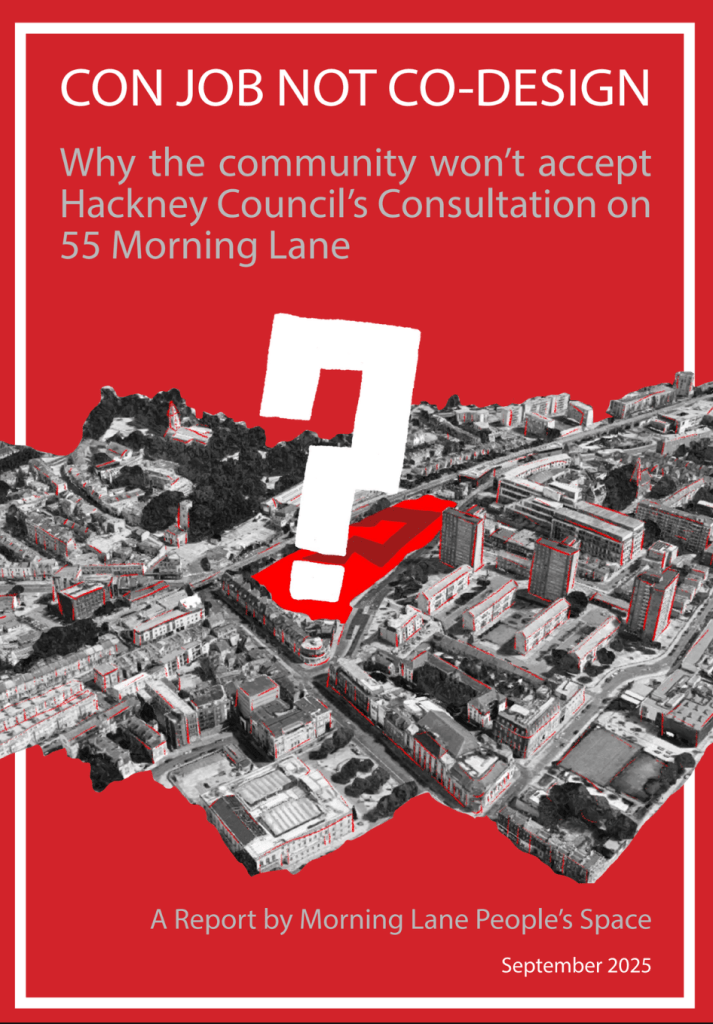
Early on, the report states: “It is important to acknowledging [sic] the community’s past frustrations and disappointments to move forward and rebuild trust to create a collaborative working environment”. This message is repeated several times, echoing our own reports. However, even as it mentions rebuilding trust, this report damages it. It does not explain why it took 15 months to publish, nor does it give a timeline for the next steps in the process. But most of all it calls the Council’s consultation a “co-design process” when it was not, and the report does not address any of the detailed critiques of it in our own report. In our report, we defined co-design and showed why this wasn’t it. The Council’s report doesn’t even attempt to justify the label.
The results of the Council’s consultation strongly support our two key and consistent campaign demands: to retain a big supermarket and for at least 50% of any homes built on the site to be council housing at social rent.
To quote the findings from the Council’s survey — which had about 400 responses, more than any of the Council’s other activities:
- “The strongest and most consistent message across responses was the need to retain a large supermarket, ideally Tesco or a store of similar or larger size.”
- “A strong priority among respondents was the delivery of genuinely affordable housing, with specific calls for council housing or social rent properties. Many explicitly rejected private flats or ‘affordable’ products they considered unaffordable to most Hackney residents.”
Similarly, the report’s top two points summarising the 122 Instagram comments are:
- “Many commenters were strongly opposed to any loss or downsizing of the Tesco store. They highlighted its essential role as a large, accessible supermarket serving local families, the elderly, and people with disabilities.”
- “Repeated calls were made for genuinely affordable housing, particularly larger homes for families and more social housing. There was widespread scepticism about “affordable” offers being primarily shared ownership or unaffordable private sales.”
The Council’s report frames resident input as “shaping” options. But it is clear that these were already structurally determined and residents were being invited to contribute only to the cosmetic arrangement of pre-set elements.
All of the report’s three design options have a Tesco that is much smaller than the current store – at about 36% of the floor space – and all of them have 25.8–26.8% social housing.
Previously we identified four strategies that the Council uses in its communications: dodging, wordiness, hiding, and omitting. This report is full of hiding and omitting.
We don’t learn anything about the deal Hackney Council did with Tesco, why the Option Agreement with Hackney Walk Ltd had no social housing requirement, or why the architect appointment wasn’t community-led. Nor, as noted above, do we learn what the Council means by co-design. Our own report on the consultation is not even mentioned in the Council’s report.
A key omission relates to viability.
In theory, viability is the way a plan is tested to see if it is financially possible. In practice, viability assessments are used by private developers to justify developments that are dominated by unaffordable private housing. The third Council workshop dealt with viability. In this workshop, residents challenged the Council’s use of the developer model and questioned the numbers they were feeding into the model. These issues dominated the workshop with a clear demand for the Council to look at alternative models and funding sources and to respond to questions such as regarding the income already earned from the land via rent and developer fees. None of these challenges make it into the Council’s report.
Above all, this report shows that the Council’s consultation was a missed opportunity. The Council should have built on existing community knowledge rather than starting from scratch, spending public money to reach fewer people with less depth.
The Council’s work involved about: 100 workshop attendees, 100 street interviews, 400 survey responses, 50 community workshop participants, and 122 Instagram responses. MOPS’s work has involved more people – 1384 people completed our first survey and 1245 people completed our second survey. We’ve held 10 public meetings attended by 30 to 100 people and spent about hundreds of hours every year talking to people outside Tesco. We’ve engaged people via TikTok, YouTube, Twitter, Instagram and Facebook with one viral post attracting 415 comments, and we’ve gone into community groups (AgeUK, a local youth group, a local church, London Renters Union, tenants groups etc).
The Council’s report is a narrative account of each of its consultation activities with a description of what happened and a summary of key points including sample quotations. In comparison, MOPS reports take an analytic approach working thematically across multiple datasets and explaining how we analysed the data and came to each of our conclusions.
It would have been cheaper and more effective if the Council had partnered with MOPS to do genuine co-design rather than employing a consultant to do — rapidly and less rigorously — what residents had already done.
This approach is a legacy of the Labour administration.
We hope that, under the new administration, Hackney Council changes tack and begins to work in partnership with us and other residents. Our position has always been the community’s position, which the Council’s own report now confirms. Partnership doesn’t require agreement — it requires shared decision-making power.

