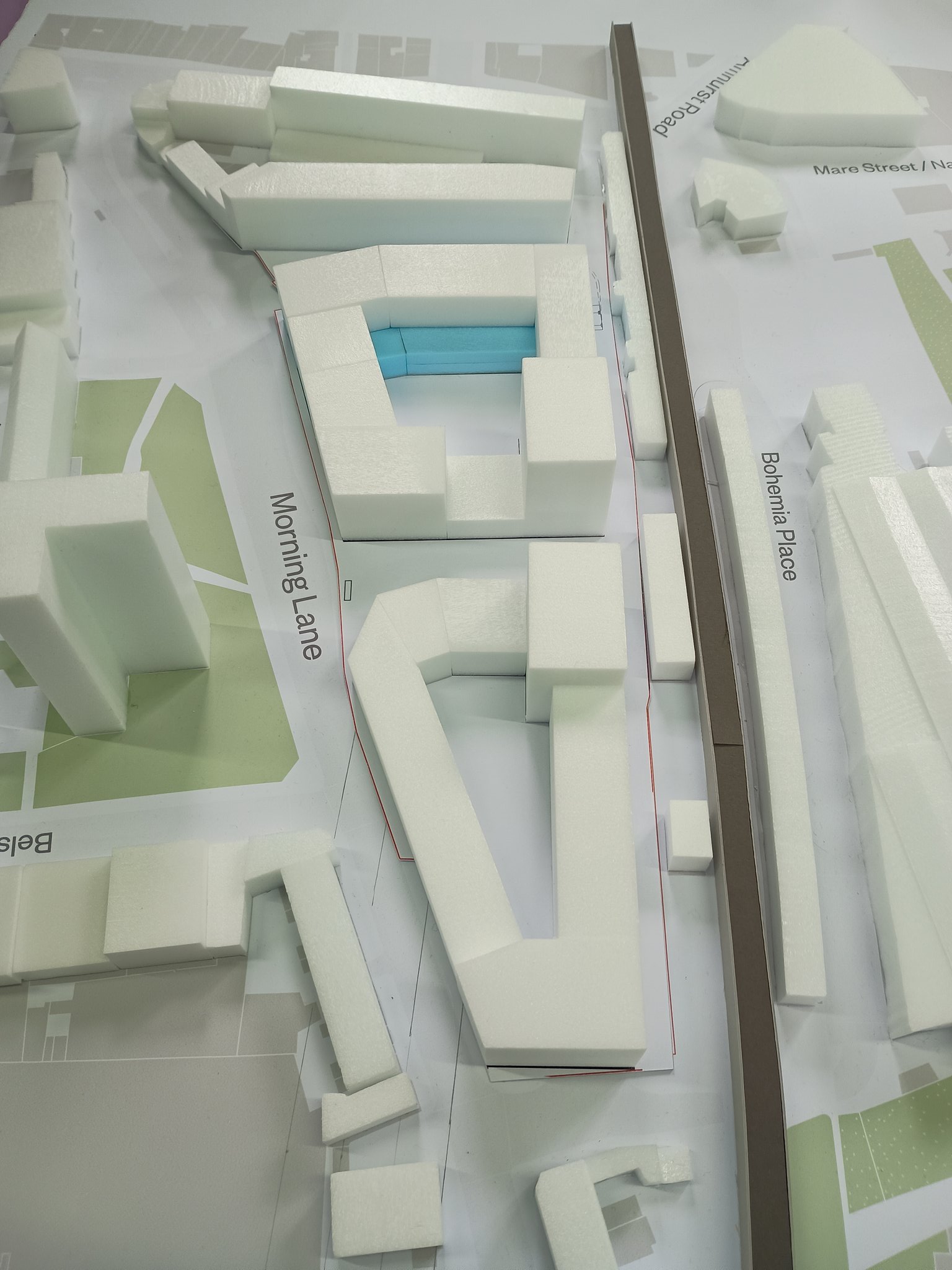
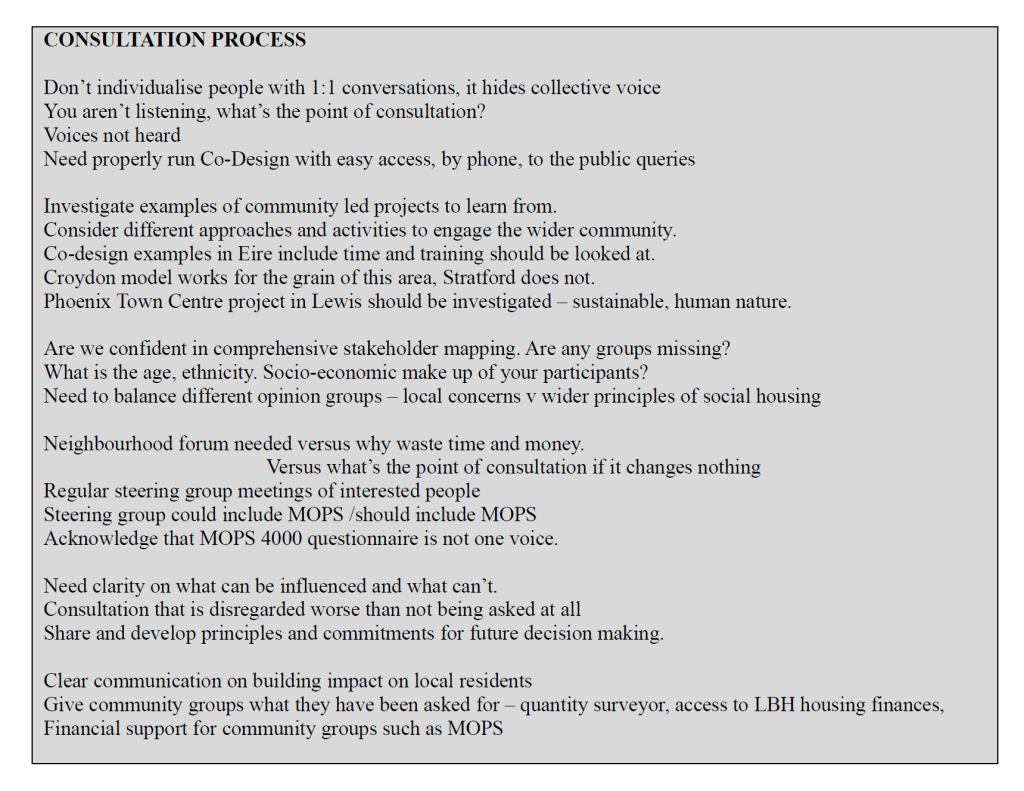
In a workshop on the 26th April, Hackney Council invited residents to look at three models of options for how they could redevelop the Tesco site at 55 Morning Lane and to comment using sticky notes. There was no introduction nor any summarising session, and the only questions written down asked people about what they wanted by way of consultation going forward. Informal conversations were encouraged, although key personnel were not easily identified. There was an expectation that public responses would target each display separately, however almost all ignored this, preferring to be unrestricted. In fact, many chose to write at length on large sheets of paper rather than confine themselves to sticky notes. We have become tired of waiting for the council to post information from this workshop, so we are doing it. Below you can see the three models and the feedback on them.
Hackney Council’s three options
There were models and boards explaining each of the three options. Photographs of the boards are below. We cannot see any way that these options were shaped by the consultation process. The two key differences between the community’s vision for the site and the Council’s are the size of the new Tesco store and the proportion of social housing. But instead of presenting options with bigger and smaller supermarkets and more and less social housing, all three designs reflect the Council’s vision. They all have a much smaller Tesco that is the minimum size that the Council is contractually obliged to build, and they all have a more-or-less identical housing mix, with 25.8-26.8% social rent homes, 17.3-17.8% shared ownership properties, and 55.3-56.8% market rate housing

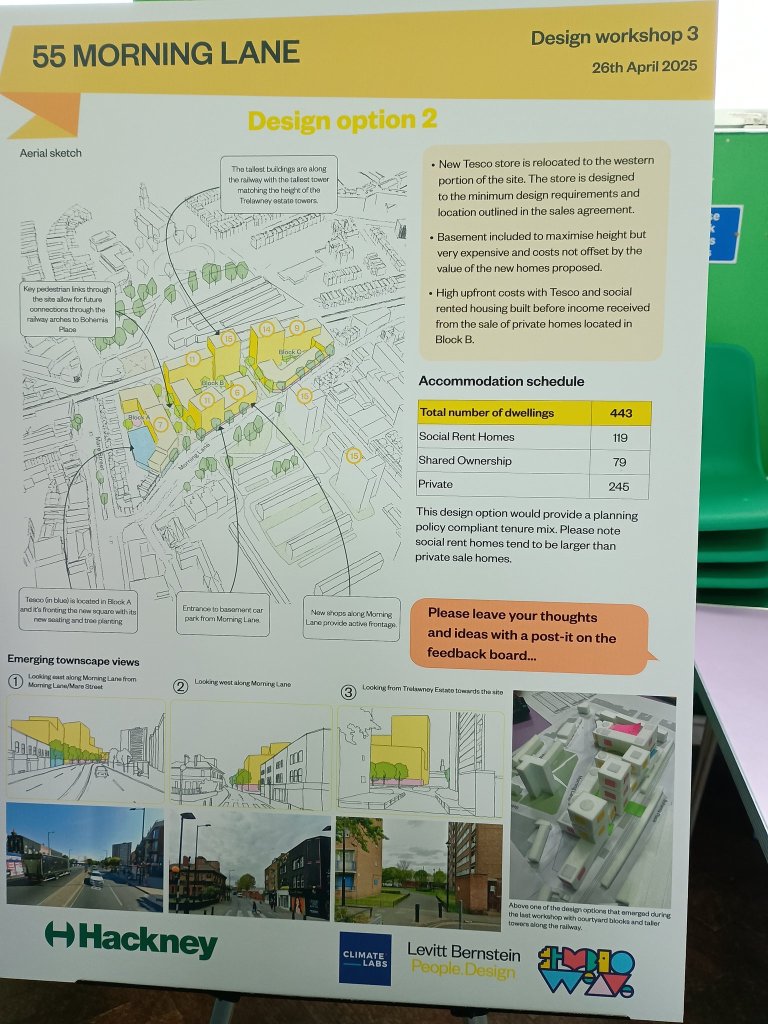
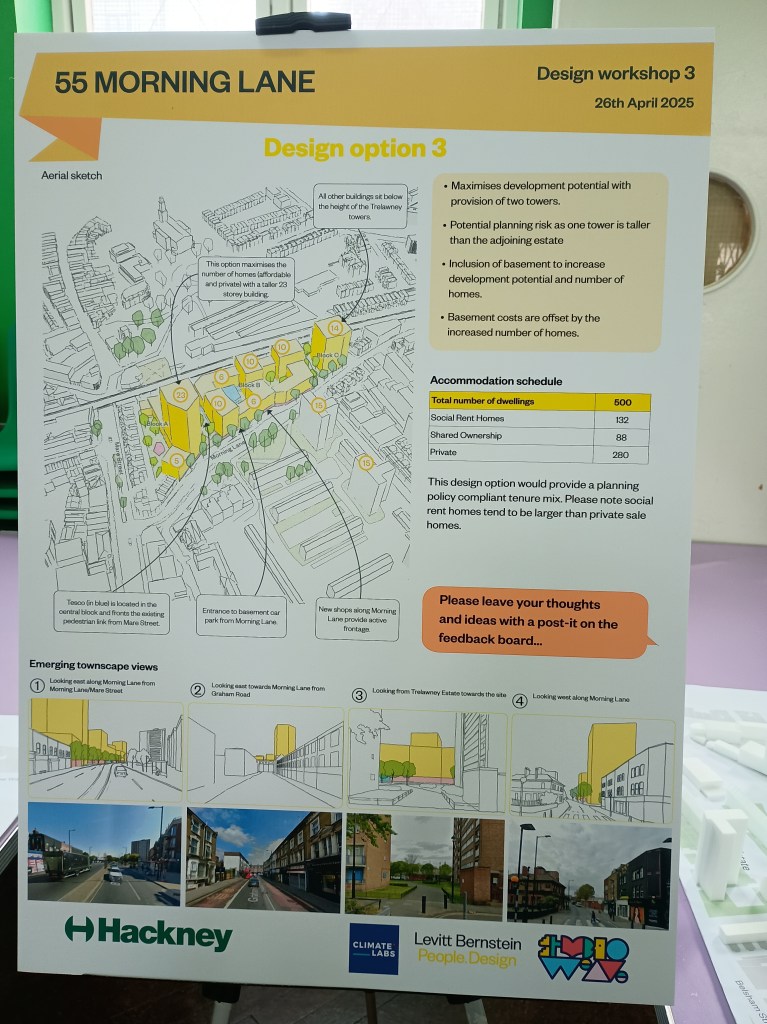
The boards accompanying the designs do not explain how residents’ views expressed in the workshops, survey and other engagement activities have influenced the designs. The rationale is purely practical and financial. Design 1 avoids the expense of basement work which caps the height of the buildings at 8 stories. Design 2 factors in the cost of basement work to allow taller buildings, but caps their heights at 15 stories, matching the only three tower blocks in the area. This means that the projected income from the market housing does not cover the development costs. Design 3 has multiple high rises including one 23-storey tower block and so contains the 500 housing units needed to cover the cost of the basement work.
How residents responded
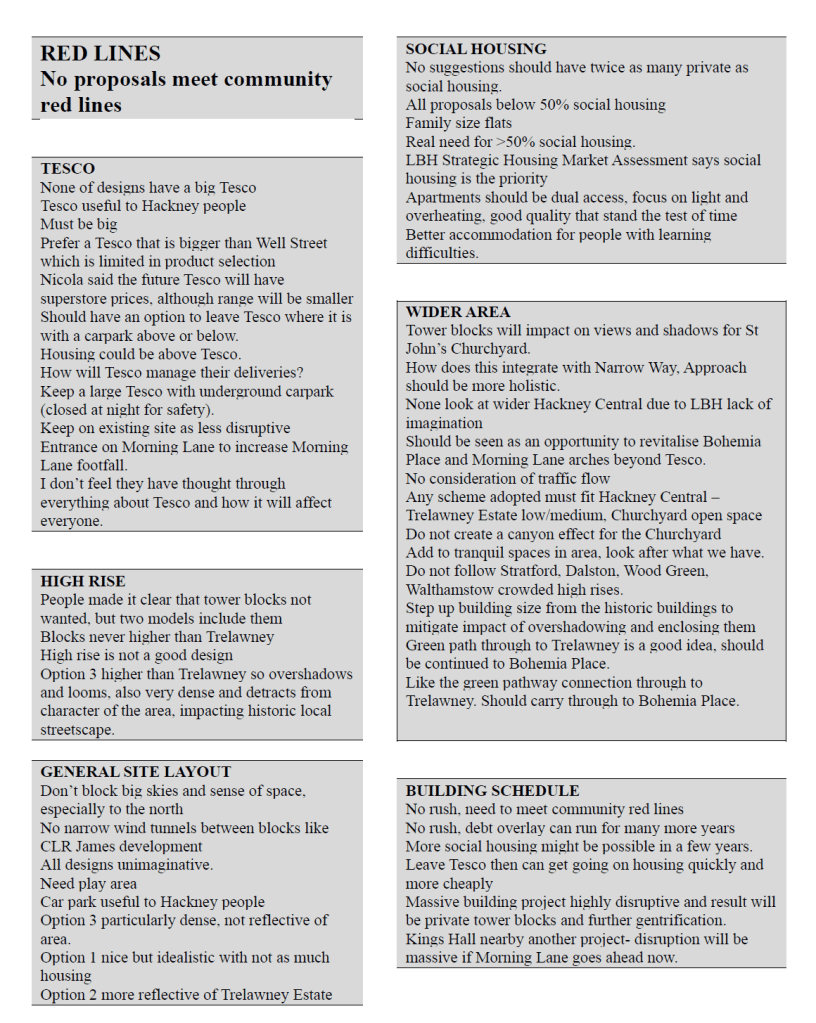
Below, we have listed and categorised all the comments from members of the public at the workshop. This workshop provided more depth and detail than the first Vision Workshop and elicited responses that reflected this progression. However, the responses only amplified those made in the Vision Workshop and there is no evidence that the community’s red lines have changed. This again shows that the Council has neither genuinely engaged nor listened, and it too has not changed its opinions. Taken as a whole, this makes depressing reading. It appears that the consultation process has not worked despite employing a co-design team.
 morninglanepeoplesspace.org